
REDUNDANCY IN FOUR SEASONS • PART 3: SPRING
In our previous article in this series (Winter - Overcoming the Stigma of Redundancy: Processing Job Loss), we explored how to handle the initial shock and shed the unearned stigma of redundancy. In Spring, we turn inward to determine your next chapter.
Once the initial dust settles, you begin to regain your footing, your psychological climate welcomes Spring and an important question arises: What comes next?
For many experienced professionals, the default reaction to a career break is urgency. Driven by financial anxiety, social pressure, or simply a desire to end uncertainty, the instinct is to jump straight back onto the job boards, send out CVs, and seek an exact replica of the role just lost.
It is a completely understandable reflex. Familiarity feels safe. However, rushing back into the market without stepping back to evaluate your direction carries a hidden risk, and misses an extraordinary opportunity.
The Trap of Familiarity: Why Rushing into a Replica Role Often Backfires
Reflexively pursuing an identical role in the same industry can lead to two common roadblocks:
Structural Economic Shifts: The job market today is evolving rapidly. Many roles, corporate structures, and middle-management layers are being permanently reshaped by automation, AI, and outsourcing. Holding out exclusively for a replica of a past role that is in decline can result in a longer, more frustrating job search.
Misaligned Re-entry: Rushing into a new position out of panic often results in landing somewhere that feels just as unsatisfying as the role left behind.
A forced career pause, as uncomfortable as it initially feels, offers a rare commodity: a blank slate. It is an invitation to pause before moving forward, ensuring your next step is driven by intention rather than inertia.
Achievement vs. Fulfillment: Why Traditional Success Stops Working
Over a long career, it is easy to confuse achievement with fulfillment.
Achievement means success in obtaining a desired status, and is external: job titles, salary bands, team size, and corporate recognition.
Fulfillment is internal, and is reached when your daily work aligns with your core values, personal drivers, and evolving life priorities.
Many mature professionals reach achievements traditionally labelled as “success,” only to realize they are burned out or disengaged, because the values that drove them in their 20s and 30s no longer match who they are today.
When you take time to unpack why certain past environments felt energizing while others felt draining, you shift from simply seeking a job to designing a career path that sustains you over the long term.
Mapping Your Real Capital: Core Values, Drivers, and Transferable Assets
A forced pause offers an opportunity to analyse your professional drivers. Here’s what these are, and why they matter:
1. Core Values: Defining Non-Negotiables
What is important to you right now? Autonomy, intellectual challenge, flexibility, leadership, or security? When a role conflicts with your core values, friction is inevitable and you will not find fulfillment.
2. Core Drivers: What Actually Energizes You
What energises you at work? Do you thrive on building initiatives from scratch, solving operational problems, or mentoring teams? If you enter a role with very little of what drives you, then you will feel drained before you start the day.
3. Transferable Assets: The Capabilities You Own
Your value was never tied to a specific company’s software or organigram. Your true assets are your adaptable problem-solving capabilities, how you manage ambiguity, how you behave in a crisis, synthesize complex data, or build trust across units. These capabilities belong to you, not your former employer. If you do not identify these, you cannot articulate what you uniquely bring to the table.
"Your value was never tied to a corporate organigram. You own your adaptable problem-solving capabilities that you will carry into your next chapter."
Alternative Operating Models: Beyond the Standard Full-Time Contract
Once your values are clear, you may realize traditional full-time employment is not the only way to deploy your talents. Many professionals use this period to evaluate:
Fractional & Portfolio Roles: Luxembourg’s evolving financial services, fund administration, and expanding tech/fintech SME ecosystems increasingly demand seasoned directors and fractional leaders without full-time overhead.
Consulting & Advisory Services: Turning decades of domain experience into targeted advisory services for organizations facing specific challenges.
Self-Employment & Entrepreneurship: Taking direct control of your time, client selection, and commercial destiny.
Selective Corporate Roles: Returning to full-time employment, but with clear criteria regarding culture, leadership, and balance.
Whatever shape your next chapter takes, the goal is the same: stepping into the market as the master of your own direction, rather than a passive applicant waiting to be selected.
From Internal Clarity to External Action
Discovering your purpose and values provides the internal compass for your career pivot. It transforms your career break from a period of unemployment into a period of strategic professional repositioning.
However, internal clarity alone is not enough. Once you know where you want to go and the story you want to tell, you must put that story out into the world, like a plant rising out of the soil.
In our next article, we will tackle the final hurdle: how unaddressed stigma tricks us into hiding, cutting us off from our strongest professional asset, and how to confidently re-engage the professional network ready to support you to achieve your next step.
YOUR SPRING CHECKLIST
Practical Do’s and Don’ts for Career Realignment
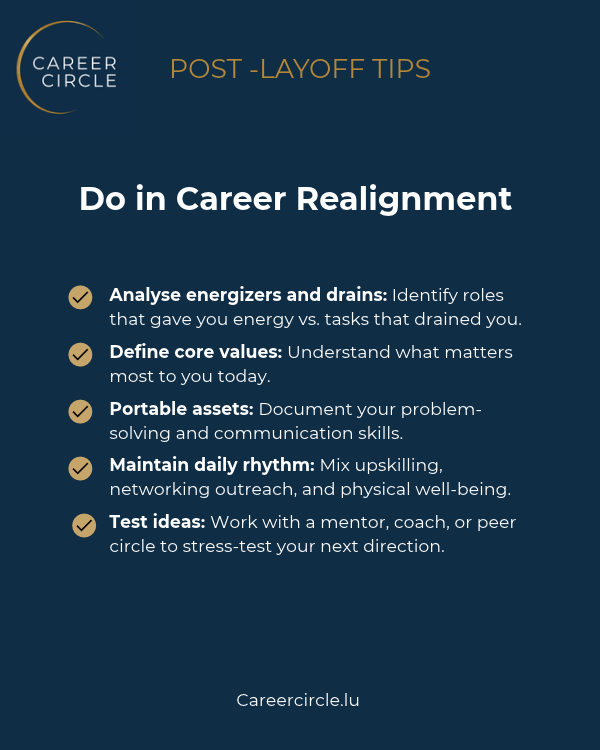
What to Do When Realigning Your Career (DO):
Analyse your energizers and drains: Review past roles and projects to identify work that gave you energy versus tasks that drained you.
Define non-negotiable values: Identify whether flexibility, autonomy, team culture, or intellectual challenge matter most today.
Build your portable assets portfolio: Document problem-solving, stakeholder negotiation, and crisis leadership skills that exist independent of any software or job title.
Establish a structured daily rhythm: Balance skill refreshes or new certifications, strategic thinking, networking outreach, and physical well-being.
Test ideas with an objective advisor: Work with a mentor, executive coach, or peer circle to stress-test your next direction.
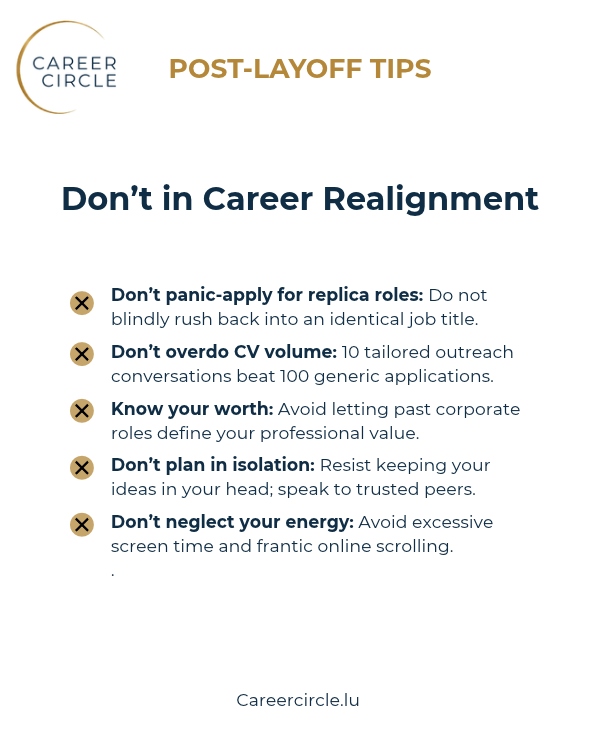
What to Avoid During a Career Pause (DON’T):
Don’t panic-apply for replica roles: Avoid rushing back into an identical job title simply to end temporary uncertainty.
Don’t measure progress by CV volume: Ten high-conviction, tailored outreach conversations outweigh 100 generic job board applications.
Don’t anchor your identity to your former employer: Avoid letting past corporate badges or organizational charts define your professional worth.
Don’t plan in total isolation: Resist keeping your transition ideas purely in your head; vocalize them with trusted peers.
Don’t neglect baseline energy: Excessive screen time and frantic online scrolling exhaust the mental clarity needed for strategic decisions.
Do you want personalized guidance on re-engineering your profile or navigating a transition? Check out our coaching packages and learn how to join our peer support network.