
This is the second article in our four-part series, Navigating Redundancy: A Journey Across Four Seasons. Read Part 1: Autumn (Pre-Redundancy & Restructuring Rumours) here.
The Reality of Garden Leave: Employed, Paid, but Not Needed
The formal meeting has happened. You handed in your badge, said a few goodbyes, perhaps less than you would have liked, and stepped out into a day where life appears to be normal for everyone else. The news has landed, and the emotional landscape shifts overnight into Winter.
Your salary still arrives but your laptop is gone. For the next few weeks or months you are employed but not expected, paid but not needed. Welcome to garden leave.
It sounds pleasant, and at first it often is. You sleep in. You finally fix the shelf. You take a walk at eleven in the morning and notice how many other people seem to do the same. Then, somewhere in the second or third week, the novelty fades and a question settles in: Who am I when nobody is waiting for my reply?
After Job Loss: Addressing the Silent Stigma in Luxembourg
The silence that follows redundancy can feel heavy and lonely.
In a professional culture like Luxembourg's, where our work is often deeply tied to our identity, social circles, and sense of stability, losing a role pulls the carpet right out from under your feet.
At Career Circle, we speak every day with experienced professionals in their 40s and beyond, who find themselves navigating this exact crossroads. Despite decades of proven capability, the immediate aftermath of losing your job can leave you filled with self-doubt, isolation, and a persistent, unmerited sense of stigma, leaving you embarrassed to tell people what happened.
To understand why this happens, and how to move through it without stalling your career, we need to look closely at both the emotional burden of job loss and the realities of modern economies.
Validating the Emotional Shock of Losing Your Job
Garden leave can bring a strange mix of relief and loss. Relief that the uncertainty is over; loss of structure, status and the daily company of colleagues. You may keep checking your phone out of habit. Some days you feel free. Other days you feel invisible. Rest assured that it is completely natural to feel overwhelmed following a redundancy.
You may also feel pressure, from yourself or from those around you, to "stay positive!" or "get straight back out there!". Every friend has advice. Articles say you should be networking, upskilling and rebranding. That pressure can turn a period of recovery into a second job you feel you are failing at.
All this advice overlooks the psychological weight of what has actually occurred. If you are experiencing anxiety about providing for your family, anger at the decision, or fear about what comes next, know that these reactions are human. Recognizing this emotional response as a grieving period is the first necessary step toward regaining control.
Redundancy is an Economic Event, Not a Personal Verdict
One of the most destructive aspects of job loss is the stigma that follows it. People frequently wonder: Why me? What did I do wrong? Will future employers think I failed?
Here, it is crucial to separate personal worth from corporate mechanics.
In today’s globalized economy, redundancy has become a routine feature of business life. Mergers, acquisitions, corporate restructuring, outsourcing, and automation happen every day. Positions are eliminated based on financial imperatives, and headcounts, not on individual capability.
Remember that your experience, leadership, problem-solving skills, and industry knowledge belong to you. Redundancy is an event that happened to your role; it is not a reflection of your competence, work ethic, or talent.
The Danger of Shame and Self-Sabotage in a Layoff
The problem with stigma is that it actively undermines you from moving forward. When we internalize redundancy as a personal failure, shame takes over.
Shame then often leads to a dangerous cycle of withdrawal. You might feel embarrassed to explain what happened, so you start to avoid talking to, or meeting people. The big danger here is that when you pull back from your community, you cut off an important support system, and the very connections and conversations that may lead to your next opportunity.
Re-Claiming Yourself: Slow Down to Move Forward
How do you break out of this cycle? The path forward requires both patience and a conscious shift in perspective.
Rest First, then Build
Think of the garden literally. Nothing grows if you dig it up every morning to check the roots. Before rushing to send out dozens of generic CVs, allow yourself the space to process the transition.
Give yourself a proper pause, a week or two with nothing to prove, before you start planning. Tired people make reactive decisions, and this is a moment for considered ones.
Then give your days some shape. Not a full office timetable, but a rhythm: a morning for thinking, an afternoon for people, time outdoors, a fixed point in the week to review where you are. Structure protects your energy and your confidence.
Give Yourself Permission to Process
Acknowledge your need for withdrawal as a time to understand your experience, a necessary pause for your mental wellbeing. This prevents further shame around feeling "lazy" or believing you aren't moving "fast enough."
The Impatience Trap: Are You Applying Towards Something, or Away from Silence?
You’re still wondering, “Should I apply now, or not?” Here the question becomes real. The paid weeks feel like a cushion, and many people either waste them or spend them in a frenzy. There is no rule that fits everyone, but here’s a useful test: are you applying towards something, or away from the silence?
If you already know what you want, and a fitting role appears, go for it. Garden leave can be a strong position: you are still employed, you are not desperate, and you can choose. If you do not yet know, a few focused weeks of reflection will make every later application sharper. Ten well-aimed applications will serve you better than a hundred hopeful ones.
Garden leave is not a waiting room. Winter is a season of its own, with its own work: to rest, to sort, to notice what wants to grow next.
“You are allowed to take it slowly. Nothing about this time requires you to be busy to be worthwhile.”
How to Talk About Redundancy: Crafting a Neutral Elevator Pitch
In this early stage, before you have clarified your next direction, do not feel pressured to broadcast an elaborate career plan. Keep your external narrative simple, objective, and ultra-neutral:
"After seven great years at Company, my role was eliminated during a corporate restructuring. I'm taking time to complete administrative steps and evaluate my next move."
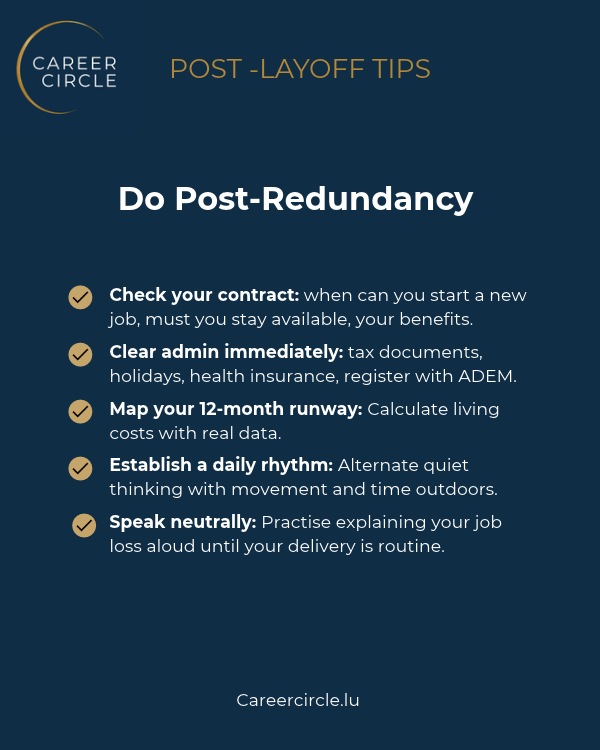
Practice this explanation out loud until you can deliver it calmly, as neutrally as describing the weather. This protects your privacy while keeping social interactions comfortable.
What Comes Next: From Internal Reframe to Purpose
Processing the emotional impact of a career break is not about dwelling on the past. Processing means rebuilding your internal foundation so that you can step back into the market with clarity and confidence.
Before you start your job search in earnest, you need to be clear on where you want to go and the story you want to tell.
Just like Winter draws to an end, in our next article in this series, we will explore how to realign with your values, what motivates you, and define who you wish to become in your next season.
Your Winter Checklist
Practical Do’s and Don’ts in Redundancy
What to Do During Garden Leave
Check what garden leave allows under your contract and local rules: whether you can start a new job before it ends, whether you must stay available, what happens to your benefits.
Complete practical admin early: your final pay, holidays, references. Register with the employment service (e.g., ADEM in Luxembourg), and review health coverage.
Calculate your financial runway: Establish a clear budget for the next 6 to 12 months to replace financial fear with facts.
Allow yourself time to process: Give yourself permission to pause without feeling guilty for not moving at maximum speed.
Have real conversations, not pitches. Ask people what they see in you; you may hear strengths you have stopped noticing.
Look after your body. Regular sleep, movement, time outdoors, and daylight do more for confidence than any online course.
What to Avoid in the Weeks Following Redundancy
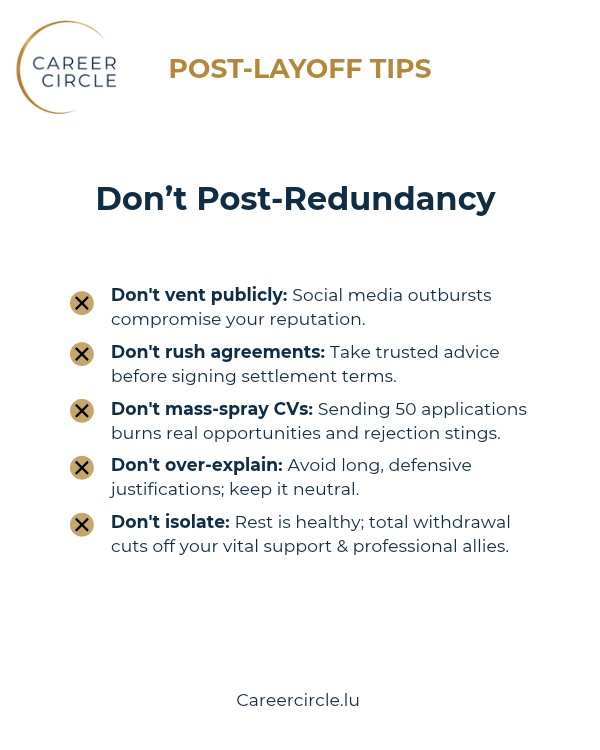
Don't post in anger: Avoid venting about your former employer on social media; public statements remain visible long after emotions settle.
Don't sign agreements in a hurry: Take the time and professional legal advice you are entitled to before signing settlement papers.
Don't shoot out 50 CVs: Firing off poorly thought-out applications in the immediate wake of shock leads to rejections that sting unnecessarily and may burn real chances.
Don't isolate completely: While avoiding high-pressure environments is sensible, stay in touch with close, trusted friends and family.
Don't over-explain your departure: Avoid rehearsing long defenses to acquaintances. Stick to a simple, neutral script about restructuring.
Don't fill every hour to avoid feeling. The discomfort is information; it tells you what matters.
Do you want personalized guidance on re-engineering your profile or navigating a transition? Check out our coaching packages and learn how to join our peer support network.