Facing Potential Redundancy: Practical Steps Before a Layoff

In our conversation with ADEM (Luxembourg’s Public Employment Service) on RTL, we spoke about the unspoken stigma that so often follows redundancy. While we highlighted the issue on air, it deserves a much deeper look, because for many experienced jobseekers, that stigma is the very thing holding them back.
This article is the first of a 4-part series designed to guide you through your career transition triggered by redundancy without shame or stigma.
Redundancy: A Journey Across Four Seasons
Redundancy rarely arrives as a single moment. It moves through seasons: the falling leaves when you sense something cold coming, the strange, suspended time of garden leave, the promise of change, and the morning when the sun finally shines bright again. These four articles follow that path, one season at a time.
Autumn: Reading the Room Before an Official Restructuring Announcement
You notice it before anyone says a word. The quarterly town hall is postponed. A consultancy comes in for "a review of the operating model". Your manager's calendar fills with meetings you are not invited to, and the person who always asks about your weekend now looks at the floor in the lift. Nothing has been announced, and yet you already know the weather is turning, and the rumour mill starts turning.
This is oftenpre-redundancy phase the hardest part, not the news itself, but waiting for it. Your mind fills the silence with worst-case scenarios. You lie awake rehearsing conversations that never happen. You reread an email three times, looking for the hidden meaning in a full stop, leaving you exhausted before the journey has even officially begun.
Pre-Redundancy: Why the Waiting Period Feels Worse Than the Bad News
Uncertainty has a nasty way of spreading beyond the job, often to insecurity in yourself. You may catch yourself wondering whether you were ever as good as you thought, whether your experience still counts, whether the market wants someone who has done this for twenty years or someone who will do it for less. You might feel angry at the company, or oddly loyal to it. You may feel guilty for updating your CV while colleagues still believe everything is fine.
All of this is normal. Uncertainty is tiring precisely because there is nothing to act on yet. The brain prefers bad news to no news, which is why so many people say, afterwards, that the announcement came almost as a relief.
Preparation Over Panic: How to Act When a Layoff Looms
Uncertainty triggers your instinct to freeze or to flee. Neither serves you well. Autumn is a time for preparation. You wouldn’t sell your house because the forecast says snow; you check the heating and stock the cupboard.
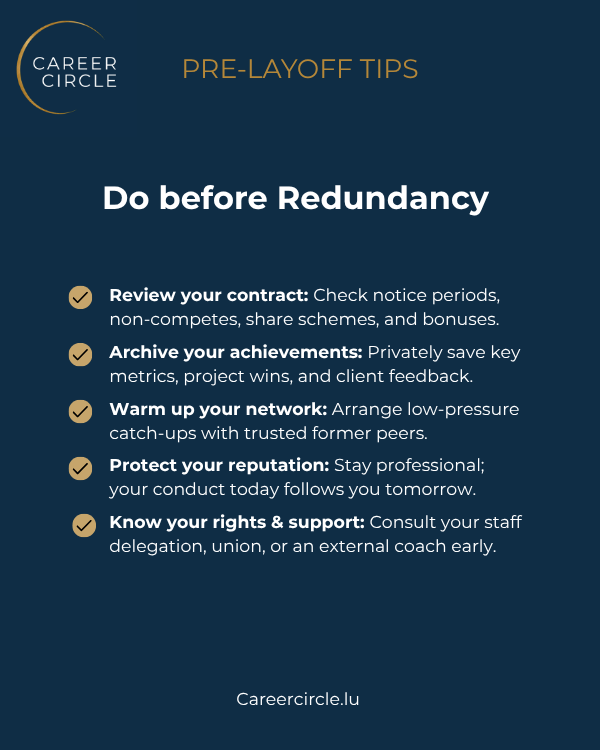
Do the same for yourself. Use this time to gather information. Review your employment contract calmly: understand your notice period, variable pay, and non-compete clauses while you are clear-headed. Keep a private record of your key achievements, project outcomes, and performance metrics; these are much harder to reconstruct from memory once corporate access is gone.
Reconnecting with Your Network Before Job Loss
A common mistake during uncertain times is participating in the rumours and negativity, or retreating entirely. Now is the time to reconnect with your professional network, before you need anything from them.
A casual coffee in Autumn is a warm conversation; a coffee after a sudden job loss can feel like a panic request. Keep your outreach low-stakes and informal. Touch base with former colleagues, comment thoughtfully on industry discussions, and stay visible without pitching or oversharing your internal anxieties.
"Don't wait for a crisis to catch up over a coffee. A conversation built on natural connection always lands better than outreach driven by urgency."
Protecting Your Reputation: Maintaining Work Standards During Corporate Layoffs
It’s human to be tempted to drop your effort to minimum output in the midst of such a difficult environment. Resist this. Your professional reputation travels with you long after a company structure disappears. Continuing to do good work during ambiguous weeks keeps your focus grounded and protects your integrity.
How you conduct yourself in uncertain times is remembered by colleagues who will eventually move to other organizations. There’s also the very real possibility that even if a redundancy plan is implemented, your name might not be on the list.
Job Search Strategy Before a Layoff: Avoiding Panic Applications
Should you start applying for jobs now? Perhaps, but very selectively. If a genuinely interesting role crosses your path, explore it. A conversation costs you nothing and gives you information. Avoid that late-night spree of twenty applications, sent to soothe the anxiety rather than to move you forward.
Ask yourself a simple question before each one: would I want this job if my current one were perfectly safe? If the answer is no, it can wait.
What Comes After the Official Layoff Announcement
Autumn marks the end of summer, but the year is not over yet. It is simply the season when you take stock, keep warm and get ready. You are allowed to feel uneasy. You are also allowed to prepare calmly for whatever comes next.
Our next article in this series Winter: Overcoming the Stigma around Redundancy, we explore how to process the emotional shock and stigma many people feel around losing their job.
Your Autumn Checklist
Practical Do’s and Don’ts in Notice Period or Pre-Redundancy
DO:
Read your contract now: Pay attention to notice periods, restrictive clauses, share plans, and bonus terms.
Log your wins: Keep a record of projects, metrics, and positive client feedback. You will need them later, and they are much harder to reconstruct from memory.
Reconnect with your network: Schedule low-pressure catch-ups with former peers and industry contacts.
Keep doing good work: Your reputation travels with you, and the way you behave in uncertain weeks is remembered.
Explore selectively: If a genuinely outstanding role appears, explore it. A conversation gives you market intelligence without commitment.
Talk to someone you trust outside the organisation: Reach out to a partner, a friend, or a coach.
Speak to your staff delegation (Délégation du Personnel) or unions (e.g., OGBL, LCGB): Consult them early to understand your statutory rights and responsibilities.
DON’T:
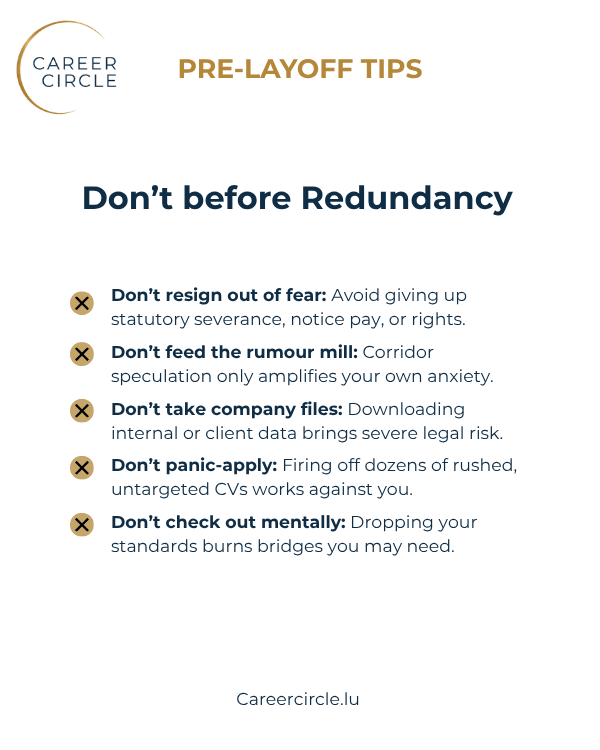
Don’t resign pre-emptively out of fear: You risk giving up severance, notice pay, or statutory support you are entitled to.
Don’t feed the rumour mill: Speculating in hallways escalates anxiety for everyone, including yourself.
Don’t download company property: Taking internal files or confidential client databases can cause severe legal repercussions.
Don’t send late-night panic applications: Mass-applying to twenty unrelated roles out of anxiety rarely shows you at your best.
Do you want personalized guidance on re-engineering your profile or navigating a transition? Check out our coaching packages and learn how to join our peer support network.